Everyone has heard of blue light. It has become the universal explanation, the one brought up at dinner, and it has ended up obscuring half the problem. Because if screens at night disrupt sleep, it's not for one reason but for two, and the second is probably the one we can most easily act upon.
I am neither a doctor nor a researcher. I am a farmer herbalist, I work on the evening, and I see many people convinced that an orange filter on their phone has solved the issue. Let's sort it out.
First mechanism: light and melatonin
Melatonin is the hormone of the night. It is secreted in darkness, its concentration peaks in the middle of the night, and it plays a role that is often misrepresented. It doesn't make you sleep: it signals to the body that the time has come. It's a messenger, not a switch.
Light, especially in blue wavelengths, blocks this production. A screen held thirty centimeters from the eyes, in an otherwise dark room, therefore sends a contradictory message to the brain: it's night outside, but it's day in front of you. The bedtime signal is delayed. This is the mechanism described in the circadian rhythm dictionary entry, and it is solidly established.
Second mechanism: content
Here is the factor that is almost systematically forgotten, even though it is at least as important. A screen does not just emit light: it provides content, and this content maintains cognitive arousal long after the device is turned off.
A news feed, a series that restarts itself, a discussion that escalates, a game that leaves you in the middle of a match: all of this keeps the mind active. You put down the phone, turn off the light, and your head keeps spinning on what you've just read. No orange filter corrects that.
The practical distinction is simple and liberating: reading ten pages of a novel on an e-reader is not the same as endlessly scrolling through a feed for twenty minutes. The brightness is comparable, the cognitive load is completely different.
Why night mode is not enough
Night modes and anti-blue light filters act on the first mechanism, partially, and on the second, not at all. They are not useless, they are incomplete. Reducing the overall brightness of the device and physically moving the screen away from the eyes play as much a role as the tint.
The shortcut is tempting: one setting, and the problem is solved. This is precisely what the blue light formula has produced most damagingly. It has transformed a behavioral question into a settings question.
What this concretely changes for the night
Two distinct effects. First, delayed sleep onset: the melatonin signal arrives later, the mind remains active, and bedtime shifts by half an hour or an hour. Over a week, the sleep debt accumulates.
Then, a more fragmented night. No one sleeps in one block: the brain briefly returns to wakefulness between cycles, about ten times a night for good sleepers, more for others, without any memory of it. This is the subject of the micro-awakening entry. Late bedtime and an agitated mind do not create these returns to wakefulness, but they increase the probability that one of these passages becomes a complete awakening, the three o'clock in the morning one from which you can't fall back asleep.
And since deep slow-wave sleep, the most restorative, is concentrated at the beginning of the night, delaying bedtime mechanically means cutting into it. The details of this architecture are in our article on sleep phases.
The three o'clock in the morning awakening
This is the complaint I hear most often, and it deserves a separate explanation. At the end of the night, cortisol gradually rises to prepare for waking: this is physiological and useful. In anxious people, this rise can occur too early, and you find yourself with your eyes open at three or four o'clock, with a strangely alert brain.
The connection with screens is indirect but real. A last hour spent on content that activates, worries, or leaves a discussion pending feeds exactly the material that the mind will ruminate on at that moment. It's not the screen that wakes you up, it's what you took with you to bed.
One thing is certain and worth saying: staying in bed ruminating does not help you fall back asleep. And if these awakenings persist week after week, they require a health professional, not a screen setting.
Screens also invite themselves into dreams
A detour that is not one. Dream banks compiled since the 1950s show that dream content reflects the era: black and white dreams were numerous in the era of black and white media, they have almost disappeared since. The visual environment of a generation is inscribed in its nights.
It would be surprising if screens and networks escaped this rule. If you want to check on your own material, submit your dreams for a few weeks and see what comes back. It's the least expensive observation, and often the most telling.
What really works
Removing screens in the evening is advice that no one applies, which makes it bad advice. It's better to replace than to remove, because the void fills itself, and rarely in a good way.
Three principles hold true. First, distinguish content: a book, a long read, a calm conversation are not enemies of sleep, unlike endless scrolling. Second, move the phone away from the bed, physically, in another room if possible: the difficulty is not the screen, it's its immediate availability. Finally, establish a competing action, something that occupies the hands and slows down the pace.
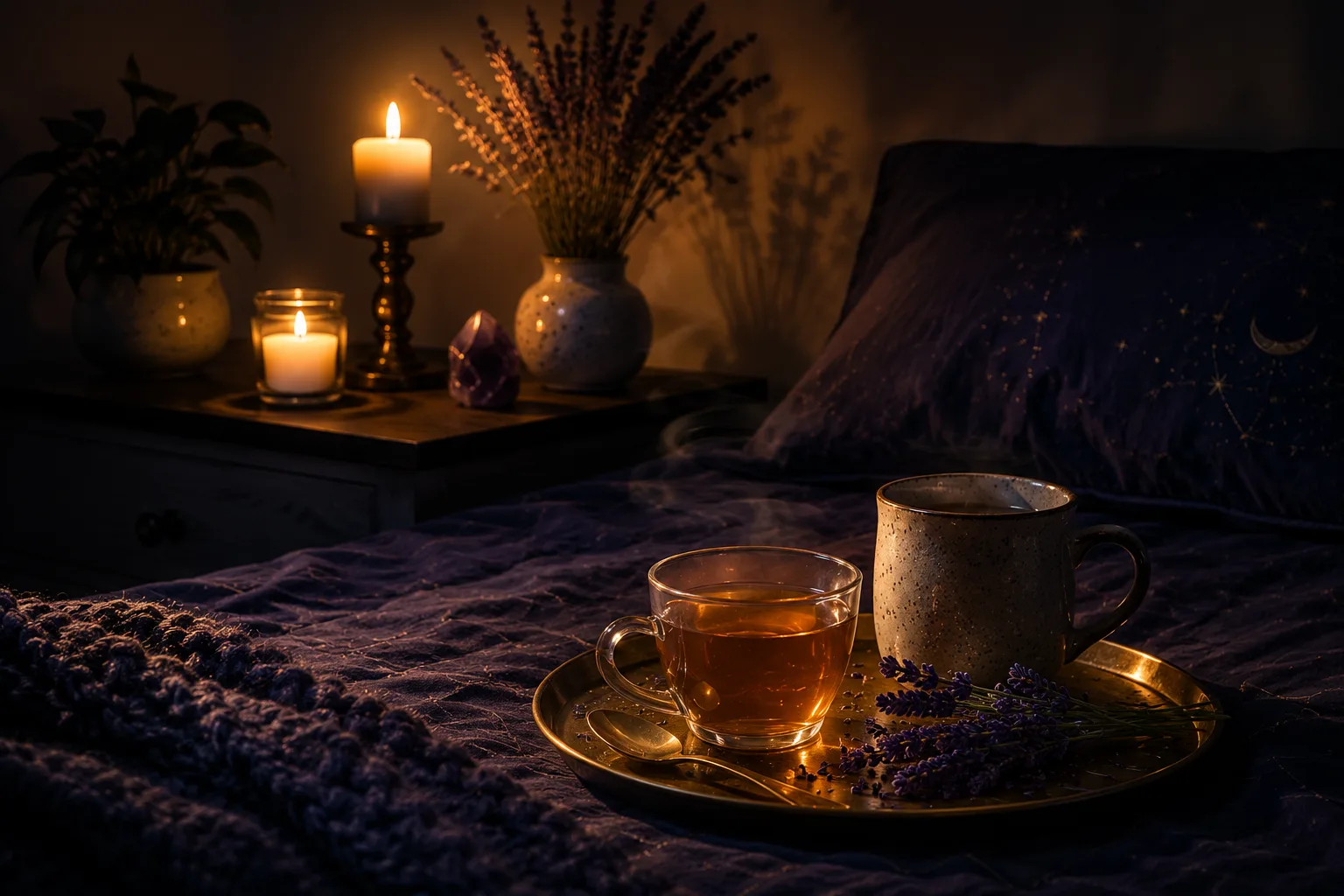
This is where the evening ritual becomes a tool and not a decoration. An infusion, low light, a cool room around eighteen degrees, a notebook placed on the bedside table. The complete sequence is described in our article on the evening ritual, and the plants we cultivate for this specific moment are at the farm shop. They don't replace the action, they make it sustainable.
The honest version
Yes, screen light delays melatonin. Yes, it is measured and documented. But if you only change one thing tonight, don't change the tint of your screen: change what you do on it in the last hour. The brain doesn't care about color temperature, it reacts to what it is given to process.
Informative article. It is not a substitute for medical advice: in case of persistent sleep difficulties, talk to a healthcare professional.