Wanting to sleep has never made anyone sleep. Sleep does not obey willpower: it arrives when a certain number of conditions are met, and it eludes us as soon as we pursue it. The good news is that these conditions are known, few in number, and depend on very ordinary actions. Light, time, room temperature, what you do with your evening.
Here's what sleep physiology says most strongly, and how we apply it on the farm, between the lavender rows and the nights of the Périgord vert.
Sleeping is not decided, it is prepared
Our body operates on an internal clock of approximately twenty-four hours. It has been known to be independent of light since 1938, when physiologists Nathaniel Kleitman and Bruce Richardson isolated themselves underground for several weeks: deprived of all external reference points, they continued to fall asleep and wake up at a regular rhythm. The clock runs by itself. Light does not create it, it sets it.
Everything that follows consists of giving this clock clear and repeated reference points, rather than forcing sleep at bedtime. This is also the principle of the evening ritual: a series of signals, always the same, that announce the night long before you close your eyes.
Light, the first conductor
Melatonin is the hormone of the night. It is secreted in darkness, reaches its maximum around two or four in the morning, and light, especially blue light, blocks its production. A detail often misunderstood: it does not make you sleep. It signals that it's time to sleep. It's an announcement, not a switch.
In practice, this results in two symmetrical actions. In the morning, seek daylight, frankly, a few minutes outdoors are better than an hour behind a window. In the evening, decrease it: low, warm lamps rather than a ceiling light, a room that gradually darkens in the hour before bedtime. The brain reads this gradient as a sunset, which it is supposed to be. To go further on this mechanism, see our sheet on the circadian rhythm.
A cooler room than you think
To fall asleep, the body temperature must drop by one to two degrees. It reaches its minimum around four in the morning. A room that is too warm mechanically prevents this descent, and falling asleep is delayed without understanding why.
The recommended range is around 16 to 19 °C. Many French bedrooms are three or four degrees above this. A warm bath or shower an hour before bedtime works by the same mechanism: the body, warmed on the surface, then evacuates its heat, and the curve drops faster.
Another little-known detail: during REM sleep, thermoregulation is suspended. The body no longer shivers or sweats to correct itself. It depends entirely on the room, which makes a temperate room all the more useful in the second part of the night.
Regularity, above all else
If you only remember one point from this article, it would be this one. A clock is set by repetition. Going to bed and waking up at similar times, including on weekends, is better than any one-off trick.
This also applies to the widespread idea that you catch up on sleep on Sunday. After a few short nights, sleeping more recovers some of the fatigue, it's true. But a debt accumulated over months is not settled by a lie-in, and shifting your wake-up time by three hours on Saturday is like inflicting jet lag on yourself every weekend. We have gathered other common misconceptions of this kind in our article true or false about sleep.
Screens: light, and especially content
The criticism of screens is well-founded, but it is often reduced to its less important half. Yes, their light delays melatonin secretion. And your phone's night filter changes something about that.
Except that the second factor weighs at least as much: the content. A news feed, a series that plays automatically, a tense discussion maintain cognitive arousal long after the device is turned off. You can have put down your phone and still have your brain in full meeting mode. The useful rule is therefore not "less blue light" but "nothing stimulating in the last hour."
The trap of alcohol, and that of caffeine
Alcohol facilitates falling asleep: this is true, and it is precisely what maintains the belief. But it suppresses REM sleep in the first part of the night, then produces a rebound effect in the second: awakenings, restless dreams, fragmented night. The balance is negative, and it is paid for in the early morning.
Caffeine, on the other hand, has a long lifespan in the body and also promotes those jolts of falling asleep called hypnic jerks, that small shock accompanied by a sensation of falling that about two-thirds of people experience. Nothing serious, but a signal that the time of the last coffee should be moved forward. These threshold images fall under hypnagogia, a fascinating state in itself.
Plants, in their rightful place
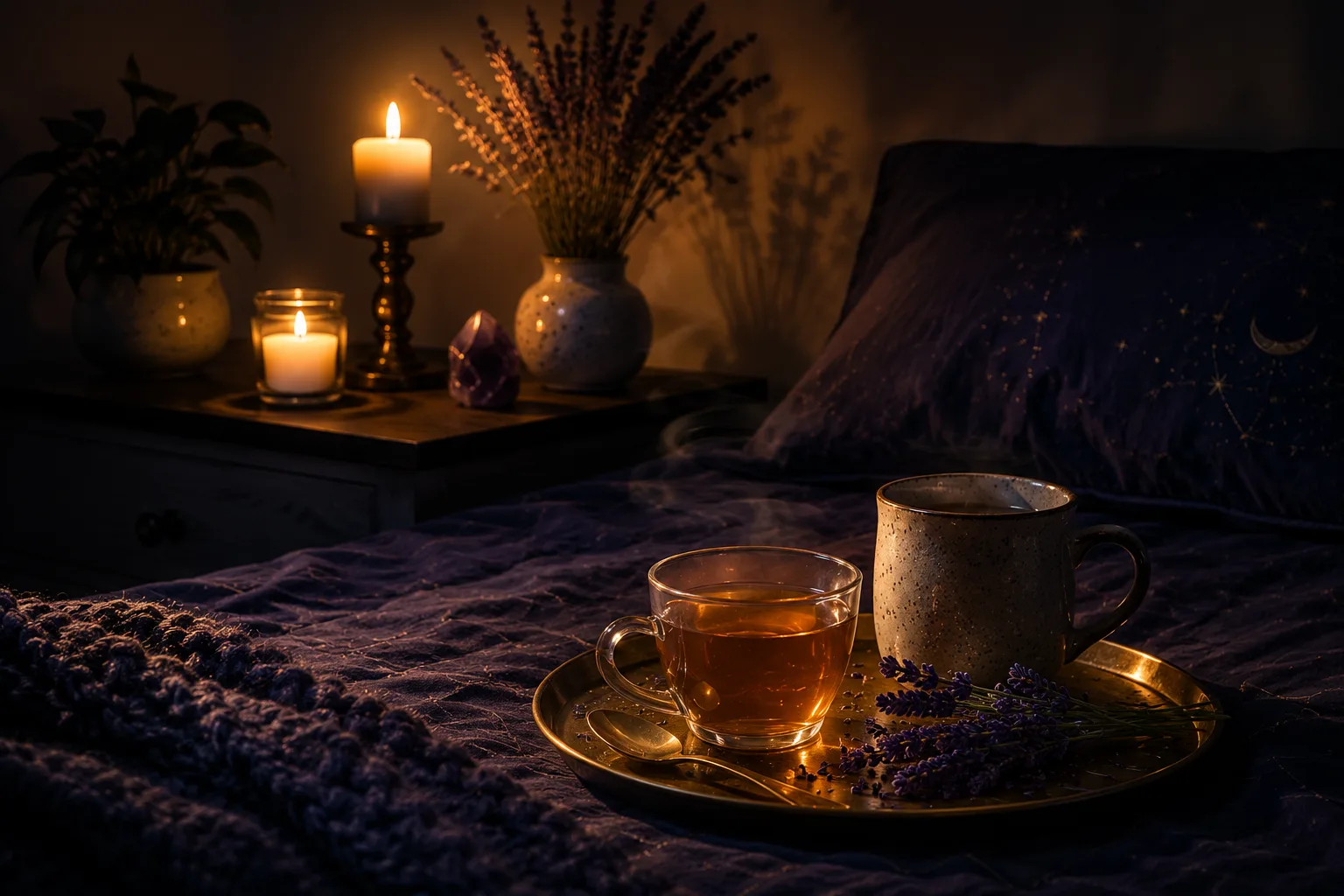
We grow evening plants and drink them every night, so let's be clear about what they do. An infusion does not replace regularity, darkness, or a cool room. It comes after, and it acts mainly as an anchor: a warm, slow, always the same gesture, which occupies the hands while the house goes dark.
Mugwort, California poppy, and lavender are traditionally associated with calm nights and memorable dreams. This is a long transmission, patiently observed, not a promise of effect. If you want to compose your own evening infusion, everything is explained in our evening range, hand-cultivated in Dordogne.
Remembering your nights
Last point, less expected. Sleeping better also changes the relationship you have with your dreams. They concentrate at the end of the night, when REM sleep phases lengthen, and it is mainly those of the early morning that we remember. Writing down what remains upon waking, even three lines, is enough to train this recall.
It's an excellent indicator, in addition to being a pleasure: a night you remember is a night you inhabit. You can submit a dream and find it again, night after night.
What doesn't fix itself
These guidelines cover most ordinary bad nights. They don't cover everything. If difficulties have lasted for several weeks, if you wake up exhausted despite full nights, if those around you report snoring with breathing pauses, you should talk to a doctor or a sleep center. This is not a failure, it is the right person to talk to.
For the rest, the night is prepared during the day. A regular clock, light at the right time, a cool room, an hour of calm before going to bed: it's not spectacular, and it's what works.
Content for informational purposes, not a substitute for medical advice.