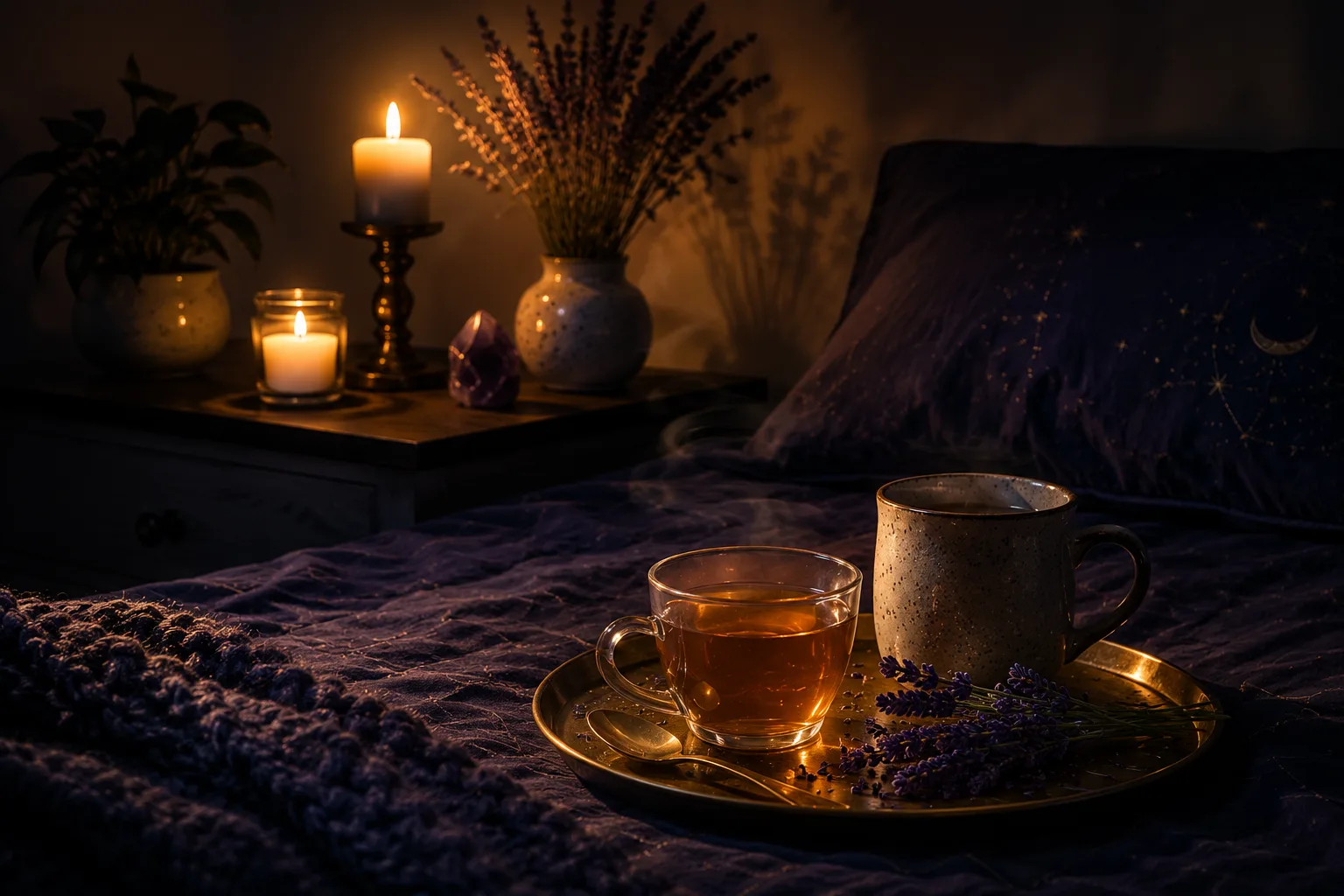
There comes a moment in an evening when everything shifts. The dishes are put away, the lights are dimmed, and a kettle is placed on the stove almost without thinking. This is where evening herbal tea makes sense. Not as a remedy, but as a signal.
On the farm in Dordogne, we hand-cultivate and dry plants specifically for this moment. The most frequent question is always the same: which one to choose? The honest answer is that there is no universal answer. However, there are families of plants, tastes, and a way of approaching them. Here's how I find my way.
What we really ask of an evening herbal tea
Let's start by clearing up a misunderstanding, because it distorts everything else. An evening herbal tea is not a sleeping pill, and does not claim to be. These are comfort plants, traditionally associated with bedtime, which are drunk warm, slowly, in a quiet room.
What acts then is largely the scene itself. The body needs to be told that night is coming before it arrives. A warm drink held in both hands, a low lamp, an armchair rather than a sofa facing a screen: these signals, repeated evening after evening, eventually form a habit that the body recognizes. This is exactly the idea developed in our article on the evening ritual, and herbal tea is the central gesture, around which the others are organized.
The gentle ones: chamomile, linden, lemon balm
This is the most consensual family, the one you offer without hesitation and drink all year round. Chamomile brings a floral bitterness recognizable among a thousand, a little apple, a little dry hay. Linden is rounder, almost honeyed, and smells of a village in June. Lemon balm, on the other hand, leans towards lemon and refreshes an infusion that could otherwise become heavy.
These three plants are traditionally used to accompany the end of the day, and they have a considerable practical advantage: their taste appeals to almost everyone, including those who don't like herbal teas. It's this trio that we combine in our simplest blend, available at the farm shop.
Dream plants: mugwort and California poppy
Second family, more distinctive. Mugwort (Artemisia vulgaris) is bitter, frankly bitter, and its reputation does not come from its taste: European traditions have long called it the herb of dreamers, and reserve a special place for it in evening uses. California poppy (Eschscholzia californica) is much milder, with its orange petals that close when day falls, as if to set an example. I dedicated an entire portrait to it, because it deserves the time.
Pay attention to what I say and what I don't say. These plants are associated with dreams by tradition, not by scientific demonstration. They do not produce dreams on command. They are companions for ritual, and that is already a lot.
The aromatics: lavender and verbena
Lavender and scented verbena primarily play on the sense of smell, and smell is an underestimated ally at bedtime. A cup of lavender perfumes the room even before the first sip. In infusion, lavender requires a light hand: too generous, it turns soapy. Verbena, more consensual, goes with almost everything. Both pair very well with California poppy, which needs to be accompanied.
Single plant or blend?
Both have their logic. Drinking a single plant is learning to recognize it. You perceive its bitterness, its fragrance, how it evolves as it cools. I always advise starting this way, one plant at a time, for a few evenings each. You discover very clear preferences.
A blend, on the other hand, corrects the flaws of each: a bitter with a sweet, a floral with a lemony. It's a work of balance, and that's exactly what we do in the workshop when we create a new reference. The goal is not to pile up as many plants as possible, but to obtain a cup that you want to have again the next day. A herbal tea you don't like is a herbal tea you won't drink.
When to drink it
Here, chronobiology provides a real benchmark. Our internal clock operates on an approximately twenty-four-hour cycle and controls, among other things, the secretion of melatonin in the dark and the drop in body temperature that accompanies falling asleep. The principle is explained in detail in the circadian rhythm entry of the dictionary.
Practical consequence: a herbal tea drunk about an hour before bedtime works well, whereas a cup swallowed while slipping under the covers is more likely to make you get up at three in the morning. Drink it early enough to enjoy it, late enough for it to mark the boundary between day and night.
What a herbal tea won't do
It won't compensate for a twenty-four-degree room, scrolling through a news feed until midnight, or bedtime hours that change by three hours from one day to the next. In this area, the environment weighs infinitely more heavily than the contents of the cup. And if your nights are consistently difficult, no plant replaces the advice of a healthcare professional: that's who you should go to, without delay.
What herbal tea does well, however, is occupy your hands, slow down the pace, and create an appointment. An appointment that can be extended: many of our clients place a notebook next to their cup and write down their dreams upon waking. If the idea appeals to you, the library gathers everything we have written about sleep and dreams, and you can also submit a dream to see what it tells.
What I keep
Choosing your evening herbal tea is not an exam. You try, you keep what you like, you abandon the rest without guilt. The gentle ones for every evening, the dream plants when you want a little mystery, the aromatics for the pleasure of the nose. The real secret is elsewhere: it's regularity that establishes sleep, and the cup is just a pretext, the best of pretexts, to grant yourself twenty minutes of calm before night.
Article for informational and cultural purposes. The plants mentioned are comfort plants and do not replace medical advice. In case of pregnancy, breastfeeding, ongoing treatment, or for a child, seek advice from a healthcare professional.