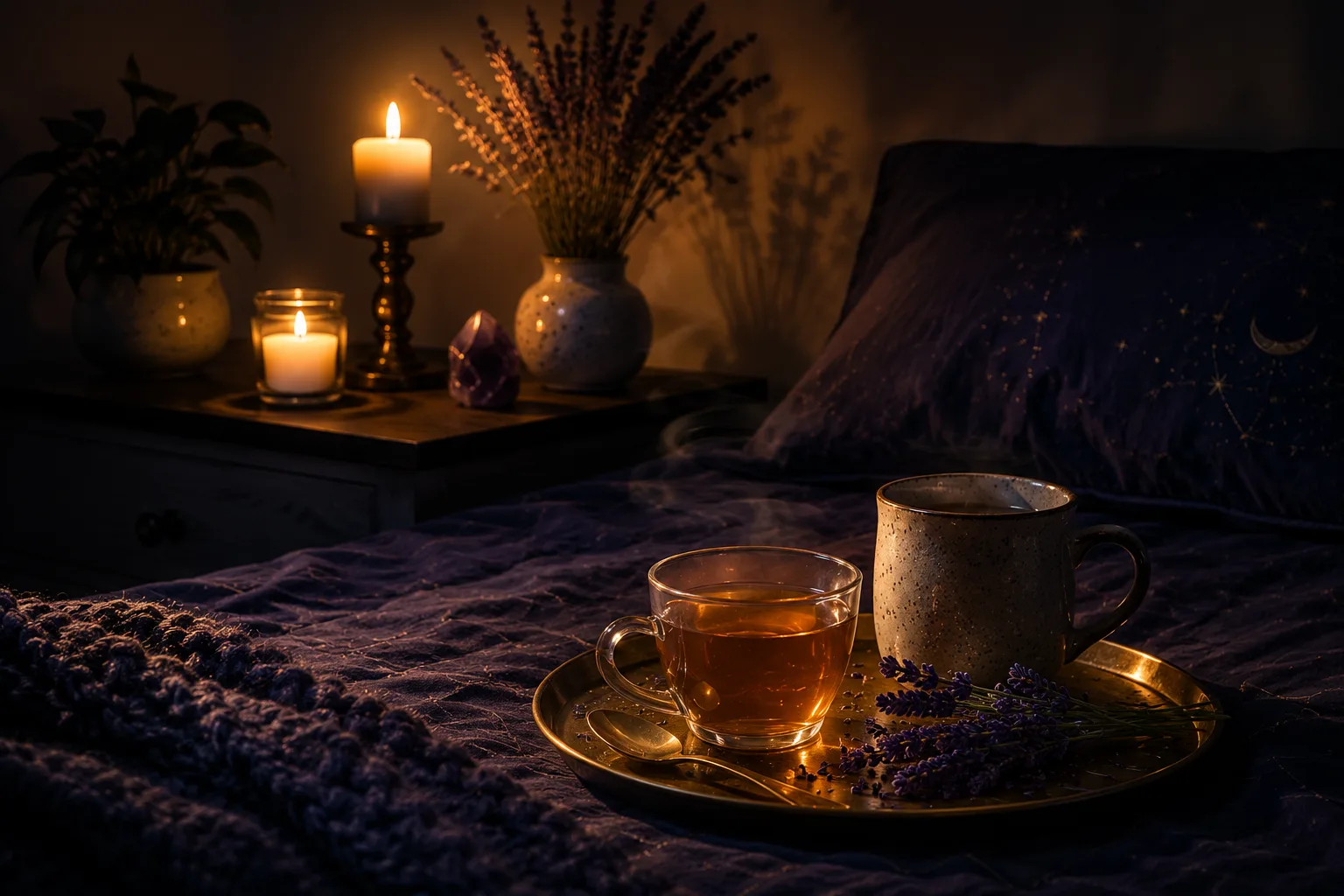
Sleep is not a switch, it's a landing. It requires a descent, and this descent begins long before you turn off the light. This is exactly what an evening ritual does: it signals to the body that the day is ending, through a series of consistent cues that it eventually recognizes without conscious thought.
There's nothing mystical about it, and nothing that requires an hour of free time. A few minutes, repeated, are better than a grand ceremony performed three times. Here is ours, as we practice it on the farm, and what sleep physiology says about each of its steps.
Why Repetition Works
Our organism operates on an internal clock of approximately twenty-four hours, which exists independently of light: physiologists Nathaniel Kleitman and Bruce Richardson demonstrated this as early as 1938 by isolating themselves underground for several weeks. This clock cannot be directly controlled, but it can be adjusted by regular cues.
A ritual is nothing more than a set of voluntary cues. The first evening, it does almost nothing. After three weeks, the mere scent of the infusion is enough to trigger a sense of relaxation. This is learning, in the simplest sense, and that's why consistency matters more than the exact content of the ritual.
First Step: Dim the Lights
Melatonin, the hormone of the night, is secreted in darkness, and light, especially blue light, blocks its production. It doesn't make you sleep: it signals that it's time to sleep. But the signal still needs to be sent.
Concretely, this means turning off overhead lights in the hour before bedtime, and preferring two or three low, warm lamps. A room that gradually darkens mimics twilight, and twilight is the only message our clock has known how to read for hundreds of thousands of years.
Second Step: Let the Body Cool Down
To fall asleep, body temperature must drop by one to two degrees, reaching its minimum around four in the morning. This is why the recommended bedroom temperature is around 16 to 19 °C (60-66 °F), often cooler than what we are used to.
A warm bath or shower, taken an hour before bedtime, uses the same mechanism in reverse: the warmed skin then dissipates more heat, and the curve drops faster. Airing out the bedroom at the end of the day, even for five minutes in winter, does the same job without a water heater.
Third Step: The Infusion, Which Occupies the Hands
Then comes the moment for herbal tea. We cultivate these plants, so let's be clear about what they do and what they don't do. An evening infusion does not replace darkness, regularity, or a cool room. It adds to them, and its primary merit is to establish a warm, slow, occupied pause.
Three plants are recurring in our herbarium. Mugwort, traditionally associated with memorable dreams, bitter, to be dosed carefully. California poppy, long used to aid sleep. Lavender, in a light infusion or as a pillow mist, for its fragrance, which quickly becomes a signal in itself. We tell the story of one of them in our article on California poppy, and the entire herbarium can be found at the shop.
Regarding preparation, simmering water around 90 °C (194 °F), five to eight minutes covered to preserve volatile aromas, and a cup drunk about an hour before going to bed rather than at the moment of closing your eyes, to avoid a nocturnal awakening that would spoil the benefit.
The gesture counts as much as the plant, and this is true for the entire ritual: what works is the consistency of the signal, not the miracle ingredient. An infusion, a lavender mist on the pillow, a lamp turned off always in the same order eventually form a phrase that the body knows how to read. There is no reason to want to reproduce our ritual identically: yours will be better because it will be yours.
Fourth Step: Put Away Screens
The criticism of screens focuses on their light, and that's true. But we forget the most decisive half: the content. A news feed, a binge-watched series, a tense discussion keep cognitive arousal going long after the device is turned off. You can put your phone down and still have your mind in a full meeting.
The useful rule is therefore not to lower the brightness but to disengage from stimulation. A paper book, a calm conversation, a low-stakes manual task work perfectly. And if the phone serves as an alarm, it can do so from across the room.
Fifth Step: Prepare for the Morning
This one is the least romantic and one of the most effective. Many anxious nocturnal awakenings are due to unresolved issues that loop in the mind. Writing three lines before bed, what needs to be done tomorrow, what remains pending, is like putting down the bag before entering the bedroom.
This is not magic: cortisol naturally rises in the late night to prepare for waking, and in stressed individuals, this rise sometimes occurs too early, leading to awakenings at three or four in the morning with the mind immediately alert. Reducing mental load in the evening does not prevent this rise, but gives it less material.
Sixth Step: The Bedside Notebook
The ritual doesn't stop at bedtime. It has a final stage, the next morning, and that's the one that changes the most things.
The dreams we remember are mostly those from the early morning, when REM sleep phases lengthen. This memory is fragile: it lasts a few tens of seconds after waking, and leaves with you if it's not captured. A notebook placed on the nightstand, three words scribbled before fully opening your eyes, are enough to train this recall week after week. Our article keeping a dream journal details the method, and you can submit a dream to keep it and compare it with others'.
If You Want to Guide Your Nights
A variant exists for the curious. Formulating a question or a simple image before sleeping, gently returning to it as you fall asleep, increases the chances of finding it in the night. This is called dream incubation, an ancient practice, without guarantee, but often surprising.
The threshold of falling asleep is also worth dwelling on for its own sake: images, shapes, snippets of scenes, this is the realm of hypnagogia, a state that artists sought to capture long before laboratories became interested in it.
Sustaining Over Time
A final word on the only real difficulty: consistency. A ritual abandoned after four evenings has produced nothing, because it works precisely through repetition. Two gestures maintained every evening are better than six gestures maintained for one week.
So start small. Dimming a light, brewing a cup. The rest adds itself, once the body understands what it's about. And if nights remain difficult despite a ritual established for several weeks, it's a doctor you should see, not just another herbal tea.
Content for informational purposes, not a substitute for medical advice. Mugwort and California poppy are not recommended for pregnant or breastfeeding women.