Les Jardins de la Lune spans a few hectares of Périgord Vert, in the north of the Dordogne, in this hedged countryside where chestnut trees eventually overtake meadows as soon as your back is turned. Here, we cultivate plants intended for the evening, dry them, process them, and package them. It's a small farm, and I do almost everything by hand.
The name comes from a practice, not a posture. Here, we plant and harvest according to the lunar calendar. I'll explain why, and especially what I honestly think about it.
Périgord Vert, what the place gives to the plants
The north of the Dordogne is not the Périgord of postcards. Less limestone, more granite and clay, more rain, humid valleys, and hedgerows everywhere. This doesn't suit everything, and it suits what we do very well.
Slightly acidic soils and distinct winters result in plants that are less bushy but denser in fragrance. Mugwort grows wild on the embankments, lemon balm settles in as soon as it finds a cool spot, and linden is a village tree found in every courtyard. We cultivate nothing that doesn't thrive here: that's the rule that simplifies everything else.
Why the moon
Lunar calendars have accompanied agricultural work for a very long time, in France and elsewhere. They distribute tasks according to the waxing or waning moon, and according to the position of the star in front of the constellations: leaf days, flower days, root days.
Let's be clear, because I'd rather lose a commercial argument than an ounce of credibility: there is no solid scientific evidence establishing that the moon improves crops. Regarding human sleep, where the question has been studied more, the slight decrease in quality sometimes observed on full moon nights is easily explained by light, especially in the countryside without shutters, and by the expectation effect. This is covered in detail in the library, and the moon entry in the dictionary tells the rest, from the symbolic side.
What the calendar truly brings me
So why do I continue? For a prosaic reason that I embrace: the calendar gives me a framework. A farm is an endless list of tasks and constant arbitration. Having days assigned in advance, leaf days for lemon balm, flower days for chamomile, forces me into an order and regularity that I wouldn't otherwise have.
It also forces me to go out at night. A harvest in the early morning under the waning moon, in September, with dew on my forearms, is not the same as a sunny afternoon. The gesture changes, the attention changes. Does the plant know it? I have no proof. The farmer, however, knows it.
The seasonal calendar
A herbalist's year resembles a rather strict score. Spring opens with young leaves, lemon balm and verbena leading the way, when essential oils are still vibrant. June is the month of flowers, linden first, for only a few days, then chamomile and lavender, harvested in the morning after the dew has evaporated and before the heat.
Summer belongs to California poppy, which re-blooms as long as it's harvested, with the entire plant being usable. Mugwort is cut at the end of summer, before the flower stalk goes to seed. Autumn is the time for roots and, above all, workshop work. Winter is for preparing the soil, pruning, repairing, and writing articles like this one.
Drying, the crucial stage
This is the most decisive and least talked about stage. A perfect harvest poorly dried is worthless, whereas an average harvest well dried remains very decent. Three requirements: complete shade, circulating air, and patience.
Our plants dry in suspended bundles or flat on racks, in the bakehouse, away from any direct light. Light destroys color and fragrance, residual moisture can mold an entire batch in a few days. The test is done by ear and by touch: a well-dried leaf cracks cleanly, a still flexible stem retains water. Only then comes the packaging, in opaque and resealable bags, because after all this work it would be absurd to let light undo the year.
The workshop, the second half of the job
One imagines the herbalist in their field. In reality, they spend less time there than in the workshop, where the transformation takes place. Herbal teas are blended by weight and by smell, balancing a bitter with a sweet, a floral with a citrusy, and re-testing until a cup is obtained that one wants to drink again the next day.
Then come the other forms: elixirs in small bottles, lavender hydrosol pillow mist, cold-process soaps that require several weeks of drying before being usable. Each step is manual, each batch is dated, and sometimes a batch fails. This is the price of small scale, and I much prefer this to a production where I would never see the raw material.
Organic, and what that entails
Organic certification prohibits synthetic products. It says nothing, however, about the size of the farm, the distance the product travels, or the hand that picked it. Yet these are the things I would like people to see.
Here, a plant travels a few tens of meters between the field and the drying room, then a few meters to the workshop. Herbal teas, elixirs, pillow mist, and soaps come out of the same room. You can see the complete range at the shop, and the portrait of the California poppy gives a good idea of how we talk about each plant: what tradition attributes to it, without making it say more.
Why a farm is interested in dreams
There is a continuity that seems strange from the outside and flows naturally here. We work on the evening, on the transition from day to night, on the gestures that accompany this shift. The night that follows is part of the same territory.
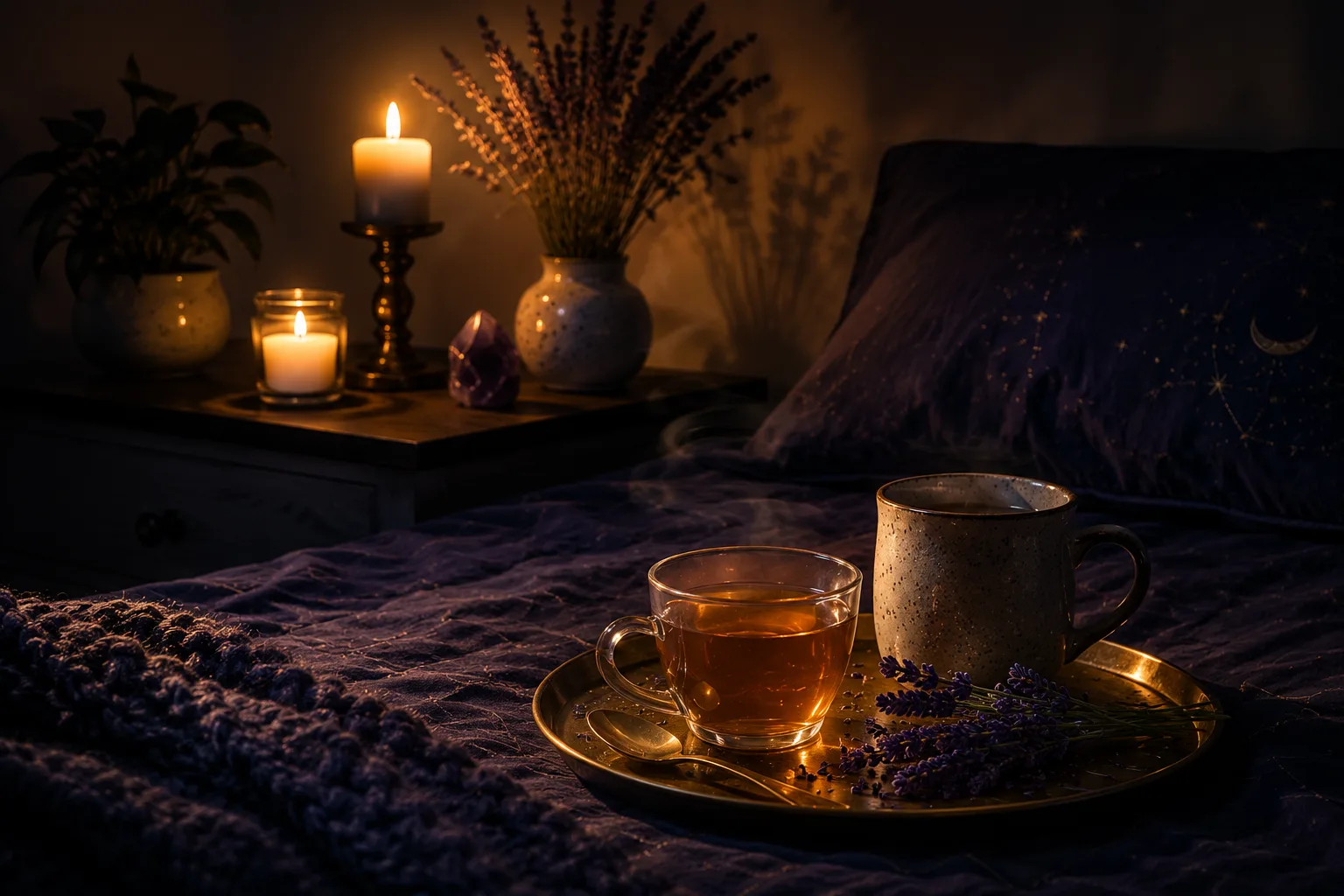
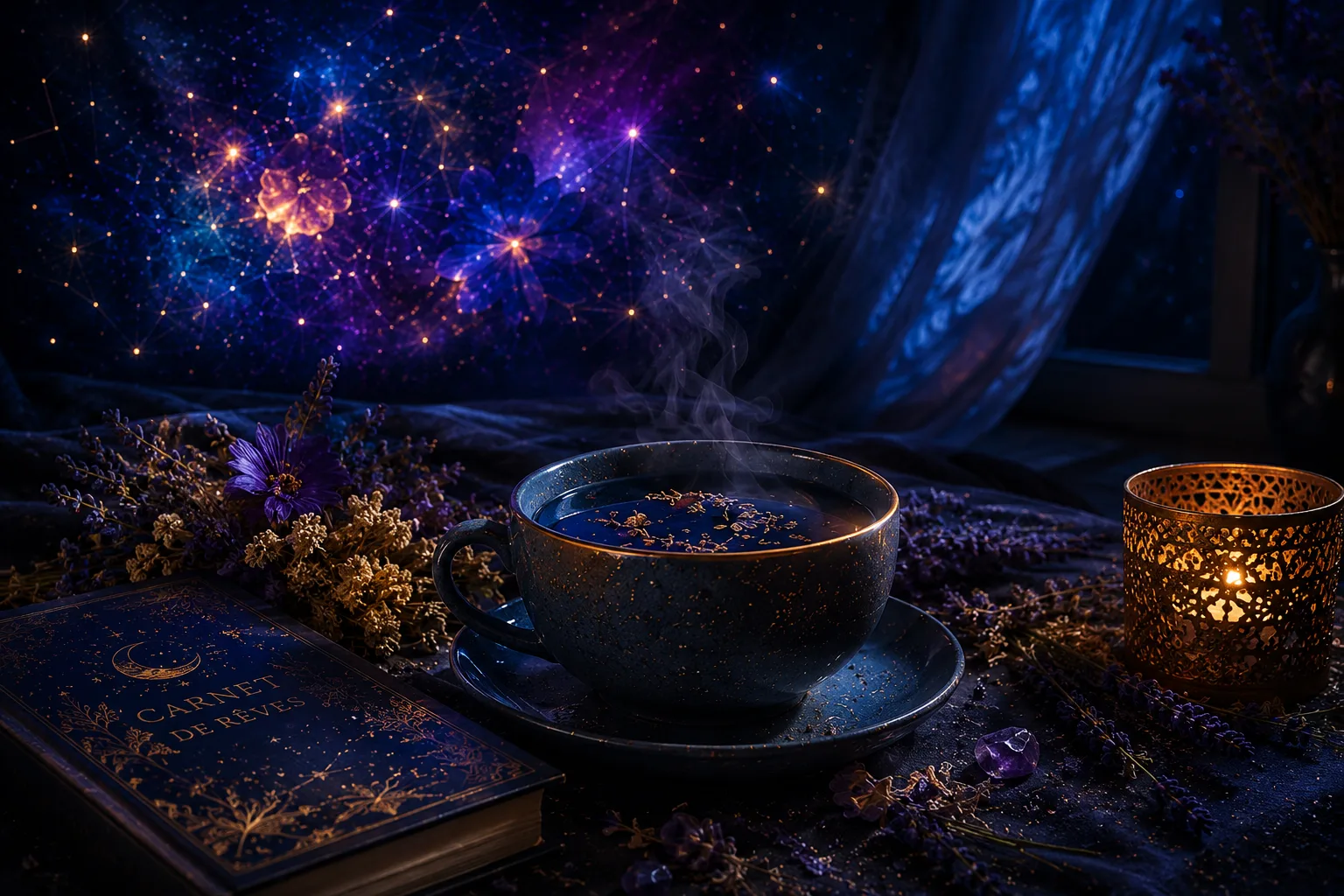
Hence the dream journal placed next to the herbal tea, hence the evening ritual we describe, hence the idea of collecting the dreams of those who read us. You can submit yours: it's free, and it has become the most vibrant part of what we do. A farm that cultivates evening plants and a community that tells its nights, it eventually forms a single subject.
A way of working
Cultivating under the moon is not believing that the star makes plants grow. It's adopting an ancient rhythm that forces slowness, observation, and regularity, in a profession where the temptation of yield constantly lurks. The result is judged in the cup, not in the calendar. And that's perfectly fine.
Article for informational and cultural purposes. The plants cultivated on the farm are comfort plants and do not replace medical advice. In case of pregnancy, breastfeeding, ongoing treatment, or for a child, consult a healthcare professional.